Typing Speed vs. Accuracy: What to Practice

If your score rises but you spend more time correcting the passage, the extra pace may not be helping your actual work. If you type comfortably and make few errors, another slow accuracy drill may not address what you want to improve either.
Choose the next exercise from the pattern in your results. A WPM number alone cannot tell you which kind of practice you need.
This guide helps you choose between accuracy work and pace practice. If you already know the recurring typo, use the worked error examples to inspect its letter order; for correction habits specifically, use the Backspace experiment.
What the research establishes
The 2018 Aalto/Cambridge study recorded 136 million keystrokes from 168,960 volunteers. Faster participants generally made and corrected fewer errors; WPM and keystrokes per character were negatively correlated at r = −0.4. That association does not establish a training prescription, or a speed at which accuracy stops mattering. Read the original study.
The practical implication is to measure correction work alongside pace. You still need your own comparable attempts to see whether a change helps.
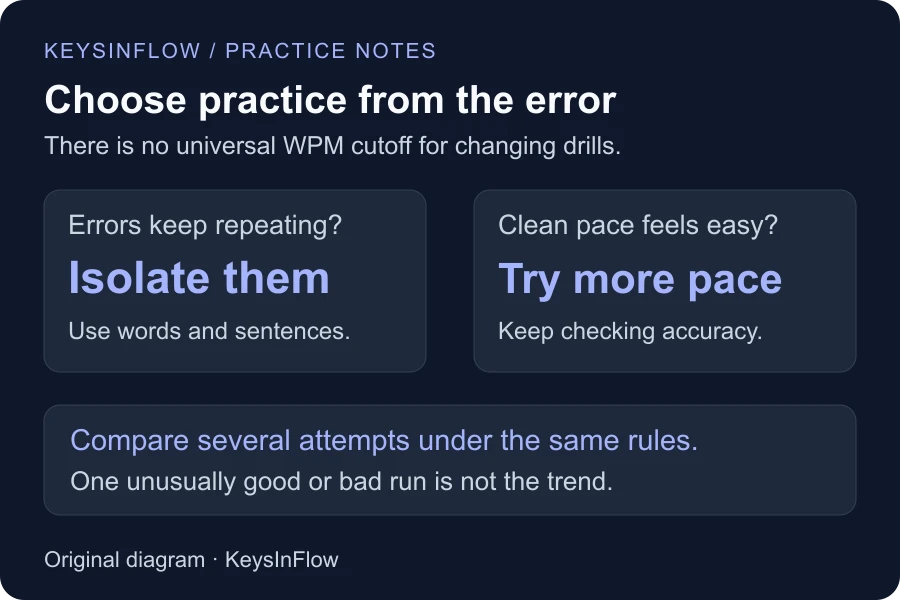
Choose a practice focus from your own results
Start with a typing test at a comfortable pace. Keep a few examples of the words you corrected. Repeat with fresh text under the same settings.
If the same reach, letter pair, capital, or space keeps failing, try the weak-key analyzer. Work on one recurring pattern slowly, then put it into different words and sentences. The weak-key drill generator can use your locally accumulated mistake data to build practice around troublesome keys.
If your ordinary pace feels comfortable and errors stay manageable, try a small increase in the pace trainer. Return to your usual pace if corrections pile up. The point is to explore a slightly harder movement while keeping a useful comparison, rather than force a personal best.
Why fixed cutoffs can mislead
There is no study-established rule that everyone should change drills at 40 WPM or 97% accuracy. Two people with the same score can have different problems: one might miss punctuation, while another reverses letters in otherwise easy words.
Text matters too. A clean score on familiar short words does not show how reliably you enter names, numbers, or code. Keep separate baselines for different material. Use our guide to typing scores when comparing tools with different scoring rules.
Use a small comparison you can repeat
Try a short session with a baseline, a focused drill, and a fresh passage. Record the duration, text difficulty, WPM, accuracy, and one recurring error. Treat the routine as an experiment rather than a guaranteed training dose.
Check several sessions before deciding it worked. Better accuracy at the same WPM can be worthwhile. A faster score with more repairs deserves another look. When a whole word gets scrambled, this guide to fast typing and wrong keys shows how to inspect the first troublesome transition.
Frequently asked questions
Should beginners focus on speed or accuracy?
Use a pace that lets you find the intended keys consistently. Work on repeated errors before adding pressure from a timer. Adjust the exercise to your own results rather than a universal beginner cutoff.
Can I practice both?
Yes. You can alternate a focused error drill with a slightly faster passage and review both numbers. Keep the conditions comparable so you can tell whether the extra pace introduces extra correction work.
Does slowing down always prevent errors?
No. A troublesome reach or an uncertain spelling can persist at a slower pace. Save the actual mistake and inspect that movement. If you are unsure of the spelling, confirm it before repeating the word.
Worked example: the same speed, different next steps
These are invented examples to demonstrate how to read a result, not measurements from users or evidence that a routine works.
| Attempt | WPM | Accuracy | What the errors show | Next exercise |
|---|---|---|---|---|
| A | 45 | 92% | The same th transition is repeatedly reversed |
Practice that transition in words, then a fresh sentence |
| B | 45 | 99% | No recurring error in this sample | Try a modest pace increase and check whether corrections rise |
Keep both tests at 60 seconds and Common difficulty before comparing them. In a KeysInFlow lesson, the result now lists missed keys with errors and total entries. “3/8 entries” means three mistakes in eight attempts at that character; eight observations are still a small sample. Use Practice missed words, then Return to lesson. The short retry does not award lesson completion.
A useful improvement might be maintaining 45 WPM while reducing repeated errors. Verify that on unfamiliar text rather than only repeating the same passage.