Typing Speed Plateau: Check Errors, Pace, and Endurance

A typing score that stays flat across several sessions is a reason to inspect the comparison before changing everything about your technique. Different passages, durations, correction rules, and keyboards can all change a result. A flat WPM also hides improvements such as fewer errors at the same pace.
This guide helps you choose the next check. It does not diagnose a fixed limit or promise that a plateau will end after a particular routine.
First check that the scores are comparable
Choose one duration, difficulty, keyboard, and correction rule in the typing test. Compare several fresh passages across sessions instead of selecting only the best result. Record accuracy beside WPM. Keep prose, code, and numeric scores separate.
Ask whether the plateau survives that comparison. If one run used familiar short words and another used punctuation-heavy code, the difference is not a clean measure of progress. Our scoring guide explains what the numbers count.
Choose the question before the tool
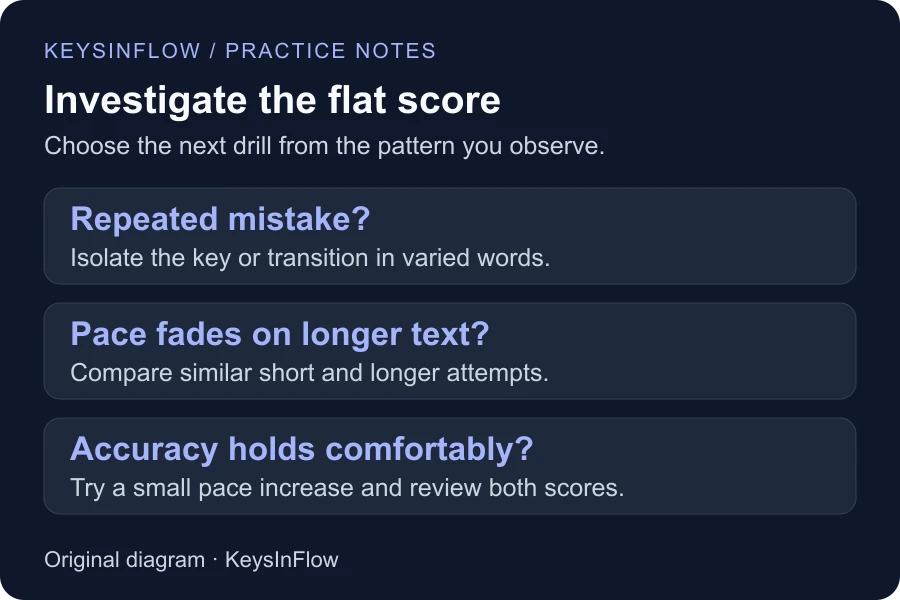
| What you notice | What to check | A useful next attempt |
|---|---|---|
| The same key or pair keeps failing | Run a single-attempt diagnostic and inspect actual examples | Practice that transition, then use it in fresh words |
| Ordinary text stays comfortable but a faster target causes errors | Try a small pace change in the pace trainer | Compare errors and effort with your usual pace |
| You slow down in longer passages | Inspect segments in the endurance test | Repeat comparable text another session before attributing the change to endurance |
| The letters are easy but numbers or symbols interrupt you | Use the relevant intermediate lesson | Compare the same kind of mixed text afterward |
A pause can include reading or an interruption. A slow character interval does not measure finger movement, and one low segment does not establish fatigue as its cause.
Try one change and keep a short record
Start with an ordinary attempt. Choose one adjustment: a troublesome letter pair, an unfamiliar symbol, or a small pace increase. Finish with fresh text under the original settings.
Write down the date, tool settings, WPM, accuracy, recurring mistake, and the adjustment. The progress dashboard can show supported local scores; add your own note about the movement because a score alone cannot explain it.
Check another session before deciding the adjustment helped. A faster memorized passage can reflect familiarity. Better accuracy at the same WPM can be a useful result. If concentration fades, take a break rather than turning a comparison into a contest with your personal best.
What learning research can tell you
Gray and Lindstedt’s paper on skilled performance discusses plateaus, dips, and leaps in learning. It provides context for why a smooth progress curve is not the only possible pattern. It does not establish that every temporary drop predicts a later gain or prescribe a typing exercise that works for everyone.
Treat a dip as an observation to review alongside the practice conditions. It can also come from different text, distraction, or an uncomfortable session. Avoid diagnosing either success or failure from a single result.
Frequently asked questions
Is a typing plateau permanent?
A flat score does not establish a permanent limit. It also cannot tell you when an improvement will happen. Inspect the task and compare a focused change over several sessions.
Should I push five or ten WPM faster?
There is no universal increment. Try a small change you can observe, and reduce the target if errors or corrections increase substantially. Keep the comparison separate from everyday work.
Should I simply practice longer?
Longer practice alone does not identify what needs attention. First check whether the issue is a recurring transition, unfamiliar text, or sustaining a comparable task. Choose an exercise for that question.
Which guide should I read next?
Use speed versus accuracy to choose a practice emphasis, worked typing-error examples for a specific typo, and the Backspace experiment when repeated correction is the habit you want to inspect.