Typing Speed Percentiles: Is Your WPM Actually Good?
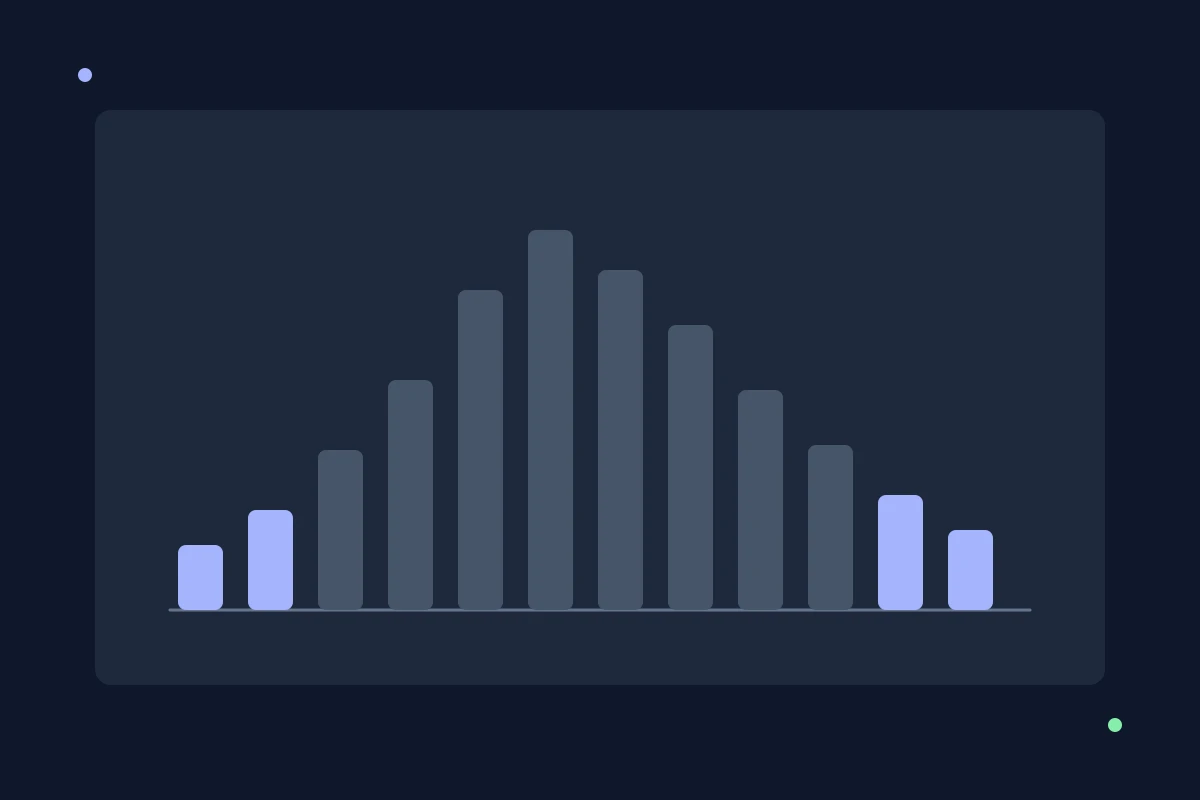
Search for a typing speed percentile chart and you’ll find a dozen versions, most with no visible source for their numbers. This one uses figures published in an actual peer-reviewed study, so you can at least know where the numbers come from, along with their limits.
The percentile breakdown, from a real dataset
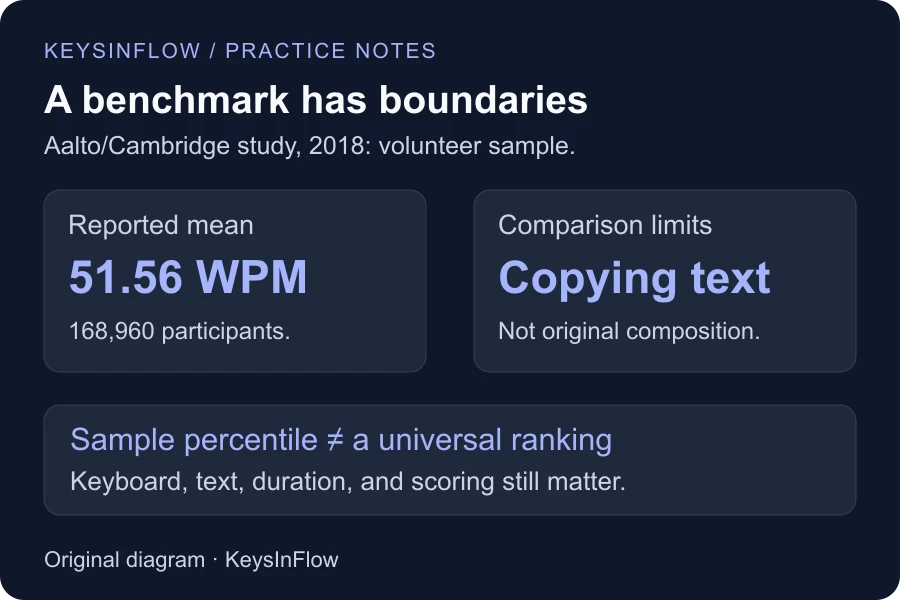
A 2018 study from Aalto University and the University of Cambridge collected 136 million keystrokes from 168,960 volunteers worldwide. The researchers reported the average WPM as 51.56, with a standard deviation of 20.2, but the more useful numbers for a percentile question are these: the slowest 10% of participants typed under roughly 26 WPM, and the fastest 10% typed above roughly 78 WPM. The very fastest typists in the dataset reached 120 WPM or more.
So a rough picture looks like this: if you’re typing under 26 WPM, you’re in the bottom tenth of this sample. Above 78 WPM and you’re outpacing 90% of the people in the study. None of these are hard cutoffs, they’re drawn from one large but self-selected sample, not a census of every typist alive.
Read the full paper, “Observations on Typing from 136 Million Keystrokes,” if you want the underlying numbers rather than someone’s summary of them, including ours.
Why the average is a little misleading
The distribution isn’t symmetrical. The researchers found a positive skew, meaning there’s a longer tail of unusually fast typists stretching the average upward, while the bulk of people cluster somewhat below it. The mean alone does not tell you the median or provide a percentile lookup for each WPM value.
It’s also worth knowing that trained typists, meaning people who reported taking a typing course, typed only about 5 WPM faster on average than untrained typists in this sample, with a similar spread in both groups. The study observed an association; it did not randomly assign people to training or establish how much taking a course would help an individual.
Why self-selected data isn’t the same as “everyone”
These were online volunteers who chose to take a typing test, which almost certainly skews toward people who already type a fair amount and are comfortable with computers. Someone who rarely uses a keyboard for anything beyond short messages isn’t well represented here. Treat these numbers as a reasonable benchmark from a large, real sample, not a scientific census of the general population.
For historical context, the same paper notes that professional typists studied on mechanical and electric typewriters between the 1930s and 1980s typically reached 60 to 75 WPM, working an average of 11 hours a week on a typewriter. Those were specialist samples, which differ from a general online volunteer sample.
What to actually do with your percentile
A percentile tells you where you stand next to other people. It doesn’t tell you whether your speed is enough for what you need it for, a data entry role, a programming job, or just personal use all have different real requirements, which is a separate question from where you rank statistically. If you’re trying to figure out whether your WPM clears a specific bar, our guide to what counts as a good typing speed covers that from the requirements side rather than the ranking side.
If you just want to know your own number first, take a one-minute typing test with consistent settings. Then track it over several sessions on the progress dashboard rather than judging yourself off a single result, since one attempt can be knocked around by an unfamiliar word or a distraction that has nothing to do with your real skill level.
Frequently asked questions
What WPM is considered fast?
Based on the Aalto/Cambridge dataset, roughly 78 WPM or higher puts you in the top 10% of the 168,960 people sampled. The fastest typists in that study reached 120 WPM or more, though those are outliers even within a fast group.
What WPM is considered slow?
Around 26 WPM or below placed someone in the bottom 10% of the same sample. That’s not a judgment on ability, since factors like keyboard familiarity, language, and how often someone types day to day all affect it.
Is 60 WPM good?
Sixty WPM sits comfortably above the 51.56 WPM average from the study but the paper does not provide an exact percentile lookup for 60 WPM. Whether that pace meets your needs depends on the task and its accuracy requirements; it does not establish a job qualification.
Do typing courses actually make you faster?
Participants who reported formal training averaged about 5 WPM faster in this sample. Because training was not randomly assigned, this association does not measure the causal benefit of taking a course.